A customer came back to one of our stores fairly annoyed.
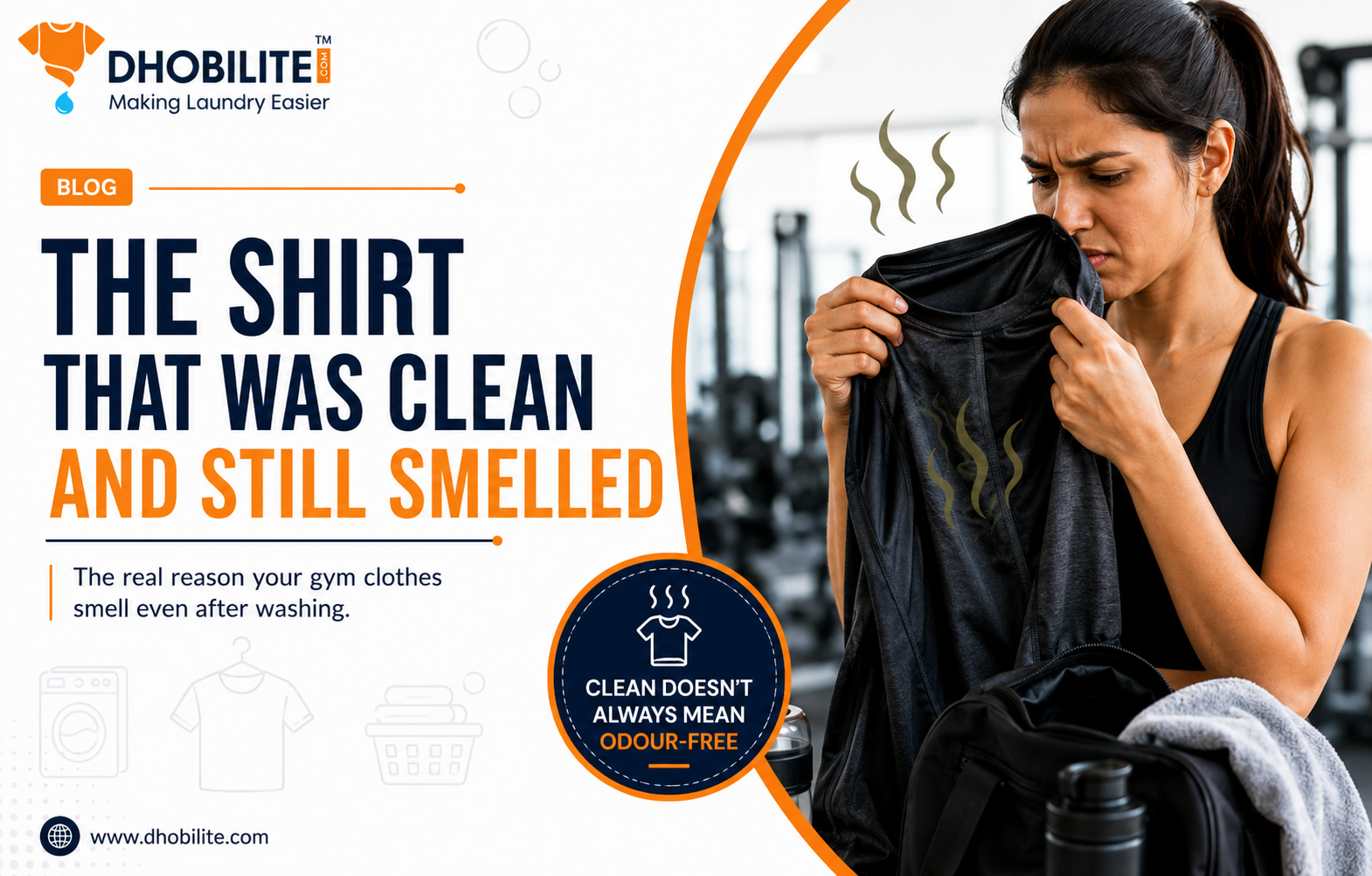
She had sent us a gym top, and we had washed it. At the counter she collected it, smelled it, and agreed it was fine.
Then she wore it to a class two days later, and about ten minutes in, it smelled like nobody had washed it in a month.
Naturally, she thought we had cut a corner, and honestly, I would have thought the same thing.
But we hadn’t. And explaining why took me down a road that eventually changed how we handle an entire category of clothing.
The wardrobe nobody adapted to
Open the cupboard of somebody who is twenty three, and count what sits inside.
Gym leggings. Training tops. Running shorts. Oversized synthetic tees. A couple of hoodies. Maybe one formal outfit hiding at the end.
Now compare that to what my generation owned at the same age: mostly cotton, some wool in winter, and a tailor stitched a great deal of it.
This, in fact, is the first generation in history whose wardrobe consists almost entirely of plastic.
Polyester, nylon, elastane, and blends of all three. Yet nobody including, for a long time, my own industry updated how we clean it.
Why plastic clothes hold smell and cotton doesn’t
This part surprised me, because the answer isn’t really about hygiene at all.
Cotton is hydrophilic. In other words, it absorbs water, which means it absorbs sweat, so in a wash that soil comes back out reasonably easily.
Polyester, however, is the opposite. Because it is hydrophobic, it repels water and that is exactly why activewear uses it, since it moves sweat away from the skin instead of holding it. But polyester is also oleophilic, which means it attracts oil. And body odour doesn’t actually come from sweat. In fact, sweat is very nearly odourless.
Instead, the smell comes from bacteria feeding on sebum, the oil your skin produces.
So you end up with a fabric that repels the water your washing machine uses, while attracting and holding the exact oily residue that causes odour. Frankly, it is close to the worst possible combination and manufacturers engineered it that way for a completely unrelated reason.
Researchers at Ghent University tested this properly. First, they put twenty six volunteers on spin bikes for an hour in cotton, polyester and blended shirts. Then they sealed the shirts in bags overnight, and the next day a trained panel smelled them.
The panel rated the polyester shirts musty, sour and ammonia-like, whereas the cotton passed clean.
When the team analysed what lived on the fabric, they found Micrococcus bacteria the ones that break body oils down into genuinely unpleasant compounds almost exclusively on the synthetic shirts.
So your gym top doesn’t smell because it is dirty. Rather, it smells because it offers a better home for the wrong bacteria.
Why a normal wash doesn’t fix it
Here is the practical consequence and it is exactly what that customer had run into.
A standard warm wash with ordinary detergent removes surface soil very well. However, it doesn’t do much about oil that has worked its way into a synthetic fibre. As a result, the garment comes out of the machine genuinely clean by every visible measure, and smelling of nothing at all.
Then you wear it. Almost immediately, your body heat and fresh moisture reactivate what the wash left behind, and the smell returns within minutes.
That is the specific, maddening thing about synthetic odour. It isn’t there when you check. Instead, it only shows up when it is too late to do anything about it.
People call it permastink, which honestly is a fair description of how it feels.
The things that make it worse
Unfortunately, most of what people do instinctively works against them.
| What people do | What it actually does |
|---|---|
| Add fabric softener | Coats the fibre in a waxy film that traps oils inside and destroys the moisture-wicking the fabric was bought for. The single worst thing you can do to activewear. |
| Use more detergent | Excess detergent doesn’t rinse fully out of synthetics. The residue holds more oil, not less. |
| Wash on a hot cycle | Damages elastane, which is what gives the garment its stretch. Ruins the fit permanently. |
| Tumble dry on high | Heat sets any remaining odour compounds into the fibre. This is often the step that makes it permanent. |
| Leave it in the gym bag | A damp synthetic garment in a sealed bag is an incubator. Hours matter here. |
| Overload the machine | Synthetics need water volume and movement to release oil. A packed drum guarantees they won’t. |
Every one of those is something a reasonable person would do believing they were being thorough.
What actually works
If you’re washing at home, start here.
First, turn the garment inside out, because the soiled surface is the one that touched your skin.
Next, get it out of the bag the moment you’re home. If you can’t wash it immediately, then at least let it dry in open air rather than sealed in a damp heap.
Reach for an enzyme detergent, which breaks down oils and proteins rather than simply lifting dirt off a surface and stick to the recommended dose, not more.
Wash warm rather than hot, around forty degrees: hot enough to work on oil, yet not hot enough to destroy the elastane.
Skip the softener entirely, every single time.
Finally, air dry where you can, and if you must use a dryer, keep it low.
For something that has already gone permanently sour, a pre-soak in a solution of water and white vinegar for an hour before washing will often break the cycle. Not always, though. Once a dryer has heat-set odour compounds into a synthetic fibre repeatedly over a year, sometimes nothing is left to do.
What we changed
For most of our history, we sorted work into two buckets: regular laundry, and delicate items that needed careful handling.
Activewear, however, sits in neither. It isn’t delicate rather, it is tough, and it needs proper mechanical action to clean at all. Yet it also can’t go through a standard hot process without the stretch dying.
So we built it a third category, with its own detergent chemistry, its own temperature, and a hard rule that nothing in that stream ever touches fabric conditioner.
None of that is complicated. What interests me is how long we took to notice the gap. Over about a decade the wardrobe changed materially, and meanwhile the cleaning industry went on treating a polyester training top like a cotton t-shirt, simply because they look similar folded.
In short, a generation quietly changed what its clothes were made of, and we didn’t update the process until customers started complaining.
What happened with that customer
At the counter I explained most of this to her, considerably less coherently than I’ve written it here.
She listened, and then said the thing that stayed with me: nobody had ever told her that her clothes were plastic.
Now, she knew the word polyester, and she had read it on labels her whole life. Yet she had never connected it to plastic, or understood why a garment could come back clean and still betray her in a spin class.
After that, she started sending her activewear separately not because we sold her anything, but because she finally knew which of her clothes needed different treatment and which didn’t.
That is usually how it goes. People aren’t resistant to doing the right thing with their clothes. Instead, nobody has ever told them what the right thing is, because the label says machine wash cold and stops there.
Frequently Asked Questions
Why do my gym clothes smell even after washing?
Polyester and other synthetics repel water but attract skin oils. So ordinary washing removes surface soil yet leaves oil bound inside the fibre, where odour-causing bacteria keep feeding. As a result, the garment smells clean until body heat and fresh moisture reactivate it during wear.
Does fabric softener help with smelly workout clothes?
No it makes things considerably worse. Softener leaves a waxy coating that traps oils inside the fiber and destroys the moisture-wicking performance you paid for. So never use it on activewear
Can I wash gym clothes in hot water to kill the smell?
Hot water damages elastane and permanently ruins the stretch and fit. Instead, aim for around forty degrees warm enough to act on oils, yet cool enough to protect the fabric.
Why does cotton not smell the way polyester does?
Cotton absorbs sweat and releases soil readily in a wash. Moreover, it supports a different bacterial population, mainly staphylococci, which produce a much milder odour than the Micrococcus species that thrive on synthetics.
How do I get the smell out of clothes that already stink permanently?
First, pre-soak for about an hour in one part white vinegar to four parts cold water. Then wash with an enzyme detergent at forty degrees, and air dry. This often works. However, if a dryer has repeatedly heat-set the odour over a long period, you may not fully reverse it.
Should activewear be washed separately from normal laundry?
Yes, ideally. It needs different detergent chemistry and a lower temperature than cottons, so keep it well away from any load using fabric conditioner.
Send Your Activewear Separately
So if your gym clothes have reached the stage where washing them no longer seems to make a difference, they need a different process rather than another cycle.
Book a DhobiLite pickup free doorstep collection, and tell us it is activewear so it goes into the right stream.
PUBLISHING PACK
Everything below sits outside the essay, matching the live template.
Featured image
- File:
dhobilite-activewear-gym-clothes-washing.webp - Alt text: Synthetic gym clothing sorted for specialist washing at a DhobiLite facility
- WebP, 1500px wide, lazy-loaded
Secondary image
- File:
dhobilite-polyester-vs-cotton-fibre-odour.webp - Alt text: Diagram comparing how polyester and cotton fibres hold body oils and cause odour
- Place directly under “Why plastic clothes hold smell and cotton does not”
Internal links to place in the prose
| Anchor on this phrase | Link to |
|---|---|
| “its own detergent chemistry” | https://www.dhobilite.com/laundry-service |
| “delicate items that needed careful handling” | https://www.dhobilite.com/dry-cleaning-service |
| “gentler on the fabric” (add to the organic mention if used) | https://www.dhobilite.com/organic-dry-cleaning-service |
External source to cite
Link the Ghent University study on first mention it is the single strongest credibility signal in the post and almost no competitor cites primary research: Microbial Odor Profile of Polyester and Cotton Clothes after a Fitness Session, Applied and Environmental Microbiology