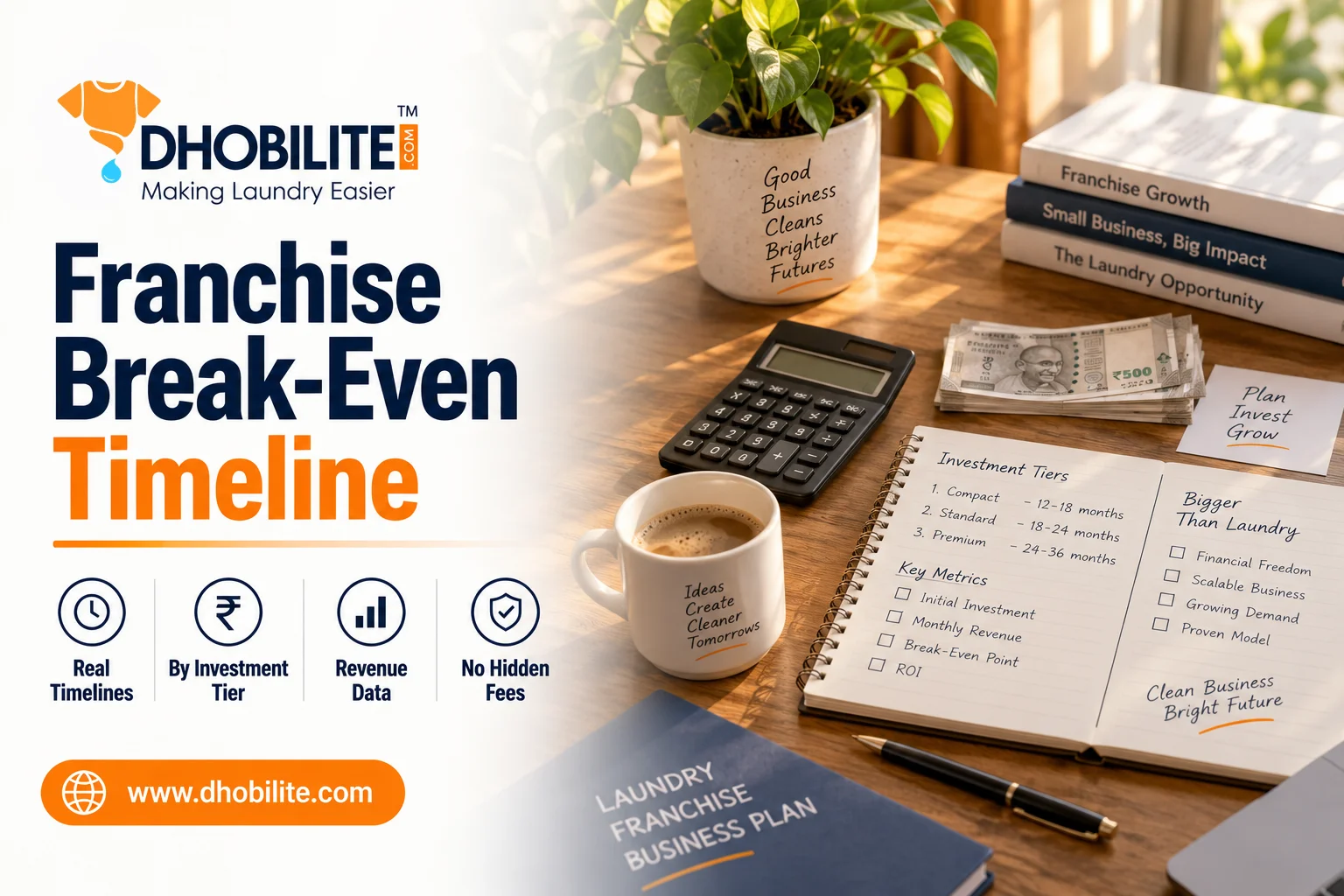
Most franchise pitches lead with the investment number and let you guess the rest. In fact, two other numbers matter more. How long until the outlet is cash-flow positive? And how long until it pays back the full investment? Here is what both actually look like across DhobiLite’s three franchise models. It is based on real operating data, not a marketing estimate.
Two Different Break-Even Numbers, Not One
Most franchise content collapses “break-even” into a single number. In fact, that number usually turns out to be the wrong one to plan around. There are actually two separate milestones, and they answer two different questions.
Operational break-even is the point where the outlet’s monthly revenue covers its monthly running costs – rent, staff, utilities, supplies. Past this point, the business is no longer burning cash every month. However, the original investment has not been paid back yet.
Capex break-even (short for capital expenditure break-even) is different. It is the point where cumulative profit has fully recovered the upfront investment itself. So it always comes much later than operational break-even. That is because it has to make up for every month the outlet spent before it, not just the months since.
Both numbers matter, but for different reasons. Operational break-even tells you how long you need to fund the outlet’s running costs out of pocket. Capex break-even tells you how long your original investment is actually at risk before it comes back.
Why Laundry Franchise ROI Looks Different in India
India’s laundry and dry cleaning market is estimated at over Rs 20,000 crore. Yet only about 5% of it is currently served by organised, branded operators. The remaining 95% is fragmented among small unorganised providers, local dhobis, and standalone shops.
That gap matters directly for break-even math. It is a repeat-purchase service with weekly or fortnightly demand, and it requires no inventory. In addition, it is driven by rising urbanisation and dual-income households. These households have stopped doing their own laundry, but they have not yet switched to a branded provider.
As a result, a franchise entering this market is not fighting an established competitor for every customer. Instead, it is converting people out of the unorganised 95%. That is a fundamentally different, faster sales motion than stealing share from a rival brand.
| Tier | Investment | Operational Break-Even | Capex Break-Even |
|---|---|---|---|
| Retail Partner | Rs 7-15 Lakhs | 2-3 months | 12-15 months |
| Live Cleaning Outlet | Rs 25-45 Lakhs | 3-4 months | 18-24 months |
| Master Franchise | Rs 1-2.5 Crore | 4-6 months | 24-36 months |
Retail Partner (Rs 7-15 Lakhs): Operational Break-Even in 2-3 Months
This is DhobiLite’s pickup-and-delivery model, built for first-time investors and residential localities. In fact, setup typically takes 4-6 weeks. That includes location selection, training, and infrastructure.
Once live, an outlet processing 30-40 kg of laundry a day typically turns operationally cash-flow positive within 2-3 months. It then reaches capex break-even, or full investment recovery, within 12-15 months. In addition, there is no on-site processing equipment to manage. Orders simply move through DhobiLite’s centralized hub factories. So the setup stays lean and the timeline stays predictable.
Both milestones scale with your regular customer base rather than footfall. A Retail Partner outlet builds toward an active base of 150-200 regular customers. Because DhobiLite runs on a repeat-order model, customers who are acquired once tend to order weekly or fortnightly. That repeat pattern, not a single large order, is what actually moves the timeline.
To put that in perspective: an outlet that reaches 150 active customers, ordering roughly once a fortnight, sits toward the slower end of both ranges. Now push the same base to weekly ordering, or grow it toward 200 active customers. Both operational and capex break-even then move toward the faster end. The investment does not change between those two outcomes. However, the speed of customer acquisition in the first few months does. That speed is what decides whether operational break-even lands at 2 months or closer to 3.
Live Cleaning Outlet (Rs 25-45 Lakhs): Operational Break-Even in 3-4 Months
A full-service storefront with on-site cleaning equipment, suited to commercial areas and high-footfall locations. Setup takes 6-8 weeks, longer than a Retail Partner outlet. That is because there is equipment to install and commission on-site.
It typically turns operationally cash-flow positive within 3-4 months, with full capex recovery in 18-24 months. So the larger setup means a longer runway to both milestones than a Retail Partner outlet. In exchange, it gets the higher throughput and walk-in visibility of a full storefront. A Retail Partner outlet simply does not have that.
The extra time to capex break-even, compared to a Retail Partner outlet, buys two things. First, on-site processing capacity that is not dependent on a hub factory’s schedule. Second, a physical storefront that generates its own walk-in demand, instead of relying entirely on delivery-app style customer acquisition. That said, both milestones still move faster or slower with the same drivers as the Retail Partner tier. Those drivers are customer base, order frequency, and how quickly the location ramps up.
Master Franchise (Rs 1-2.5 Crore): Operational Break-Even in 4-6 Months
A city-level, zone-ownership model built around a dedicated processing facility that serves multiple Retail Partners across the zone. Setup takes up to 12 weeks, the longest of the three tiers. That is because it includes standing up an actual processing factory, not just a single outlet.
It typically turns operationally cash-flow positive within 4-6 months, with full capex recovery in 24-36 months. That makes it the longest of the three tiers on both counts. In exchange, the structure is fundamentally different, not just bigger. A Master Franchise processes orders for an entire zone’s worth of Retail Partners and direct customers, not one location’s walk-in traffic.
So the 24-36 month capex window reflects a different kind of business, not a slower version of the same one. A Retail Partner or Live Cleaning outlet operates from one location. A Master Franchise, on the other hand, operates through every Retail Partner it onboards in its zone, on top of its own direct processing volume. As a result, its growth trajectory does not simply track the size of the extra investment. Instead, it compounds as the zone fills in with sub-franchise partners.
How the Hub-and-Spoke Model Connects the Three Tiers
The reason a Master Franchise’s numbers look structurally different from a Retail Partner’s comes down to how DhobiLite’s operating model is built. It is not just a bigger version of the same thing. A Master Franchise runs on a hub-and-spoke structure. There, a central processing facility of 3,000+ sq ft acts as the hub. It handles the actual washing, drying, and finishing for the zone.
In turn, Retail Partner outlets across that zone act as spokes. They handle customer-facing pickup and drop-off, without needing any processing equipment of their own. This is also why a standalone Retail Partner outlet can start at Rs 7-15 lakhs. It does not need its own processing setup. Instead, it simply plugs into DhobiLite’s existing hub-factory network, rather than building one from scratch.
A Master Franchise investor, in contrast, is buying the hub itself. On top of that, they get the right to onboard and earn from every spoke that connects to it. So that structural difference, not just a bigger number on the same kind of outlet, is what separates a 12-15 month capex break-even from a 24-36 month one.
What Actually Drives Break-Even Speed
Both the operational and capex ranges above are ranges, not fixed dates. In fact, the same tier can land at either end depending on a few concrete factors:
- Location. DhobiLite’s own site-selection criteria prioritise high visibility, accessibility, proximity to demand, and realistic customer footfall. So an outlet that meets all four from day one ramps up faster than one that compromises on any of them.
- Order density, not just customer count. A Retail Partner base of 150 customers ordering weekly outperforms 200 customers ordering monthly. In other words, frequency compounds faster than headcount.
- How quickly the local team executes early marketing. DhobiLite provides marketing support and a launch campaign at every tier. However, the pace of the first 90 days still depends on how actively a franchise partner runs it.
- Tier-specific infrastructure dependencies. A Retail Partner outlet depends on hub-factory turnaround time. A Live Cleaning Outlet depends on its own equipment uptime. A Master Franchise, meanwhile, depends on how fast it onboards Retail Partners into its zone.
Who Each Tier Actually Fits
In every case, the core requirements are the same across all three tiers. That means a genuine interest in running the business day to day, meeting the financial criteria, and access to a location that fits the site-selection criteria above. What differs is what each tier asks of the person running it.
A Retail Partner outlet suits a first-time investor who wants a lean, delivery-first operation without managing processing equipment. A Live Cleaning Outlet, on the other hand, suits someone with access to a high-footfall commercial space. They want a visible storefront presence. A Master Franchise suits an investor thinking in terms of a zone and a small network of sub-franchise partners, not a single outlet.
It is also not an either-or decision made once. In fact, franchise partners who meet the financial and operational criteria can own and operate multiple DhobiLite outlets. A number of existing partners already hold multiple franchise rights rather than stopping at one.
What the Investment Actually Covers
Every tier’s investment figure includes the franchise fee, equipment, branding, and three months of working capital. Also, there are no hidden royalty deductions taken out of daily revenue.
In addition, DhobiLite provides comprehensive training at every tier. This covers operational processes, marketing strategy, and customer service, along with ongoing support after launch rather than a one-time handover. That support extends to the brand and technology layer too. So franchise partners operate under an established, recognised brand. They also get a technology-driven booking and operations platform behind them, rather than building customer trust and back-end systems from zero.
Why the Range, Not One Fixed Number
Break-even depends on local order volume, location footfall, and how quickly a franchisee’s territory ramps up customer acquisition. As a result, two Retail Partner outlets in different cities can land at opposite ends of the 12-15 month capex range. That is exactly why DhobiLite’s team shares a projected financial model specific to your city and location. It happens during the franchise consultation, rather than relying on a single number meant to fit every market.
Frequently Asked Questions
1. What is the difference between operational break-even and capex break-even?
Operational break-even is when the outlet’s monthly revenue starts covering its monthly running costs. So the business stops needing to be funded out of pocket. Capex break-even is when cumulative profit has fully paid back the original investment. So operational break-even always comes first, by a wide margin. That is 2-6 months across DhobiLite’s tiers, versus 12-36 months for full capex recovery.
2. What is the fastest way to break even on a DhobiLite franchise?
A Retail Partner outlet in a residential locality with steady daily order volume (30-40 kg/day) reaches both milestones fastest. In fact, that means operational break-even in 2-3 months, and full capex recovery in 12-15 months.
3. Does a higher investment mean a longer break-even period?
Generally yes, on both measures. A Master Franchise takes longer to reach operational break-even (4-6 months) and capex break-even (24-36 months) than a Retail Partner outlet. However, it also operates across an entire zone’s worth of Retail Partners, rather than a single location.
4. How long does it take to actually set up a DhobiLite franchise?
4-6 weeks for a Retail Partner outlet, 6-8 weeks for a Live Cleaning Outlet, and up to 12 weeks for a Master Franchise. This covers location selection, training, and infrastructure setup. All of it happens before either break-even clock even starts.
5. Is a DhobiLite franchise actually profitable?
Yes, for franchisees who follow the operating model, market actively, and manage costs well. In addition, DhobiLite provides comprehensive training and ongoing support. This is specifically meant to keep outcomes consistent across partners, rather than leaving profitability up to chance.
6. What is the minimum investment to get started?
A Retail Partner franchise starts at Rs 7-8 lakhs, covering setup costs, fees, and basic equipment. Depending on the city and tier chosen, the investment scales up to Rs 2 crore or more for a Master Franchise.
7. Can I own more than one DhobiLite franchise?
Yes. In fact, qualified franchise partners can own and operate multiple outlets, subject to meeting the financial and operational criteria. In fact, a number of existing partners already hold multiple franchise rights.
8. Are these break-even estimates the same in every city?
No. Both operational and capex break-even depend on local order volume and footfall. So DhobiLite provides a city-specific financial projection during the franchise consultation.
Full investment breakdown across all three models: dhobilite.com/be-our-franchise-partner