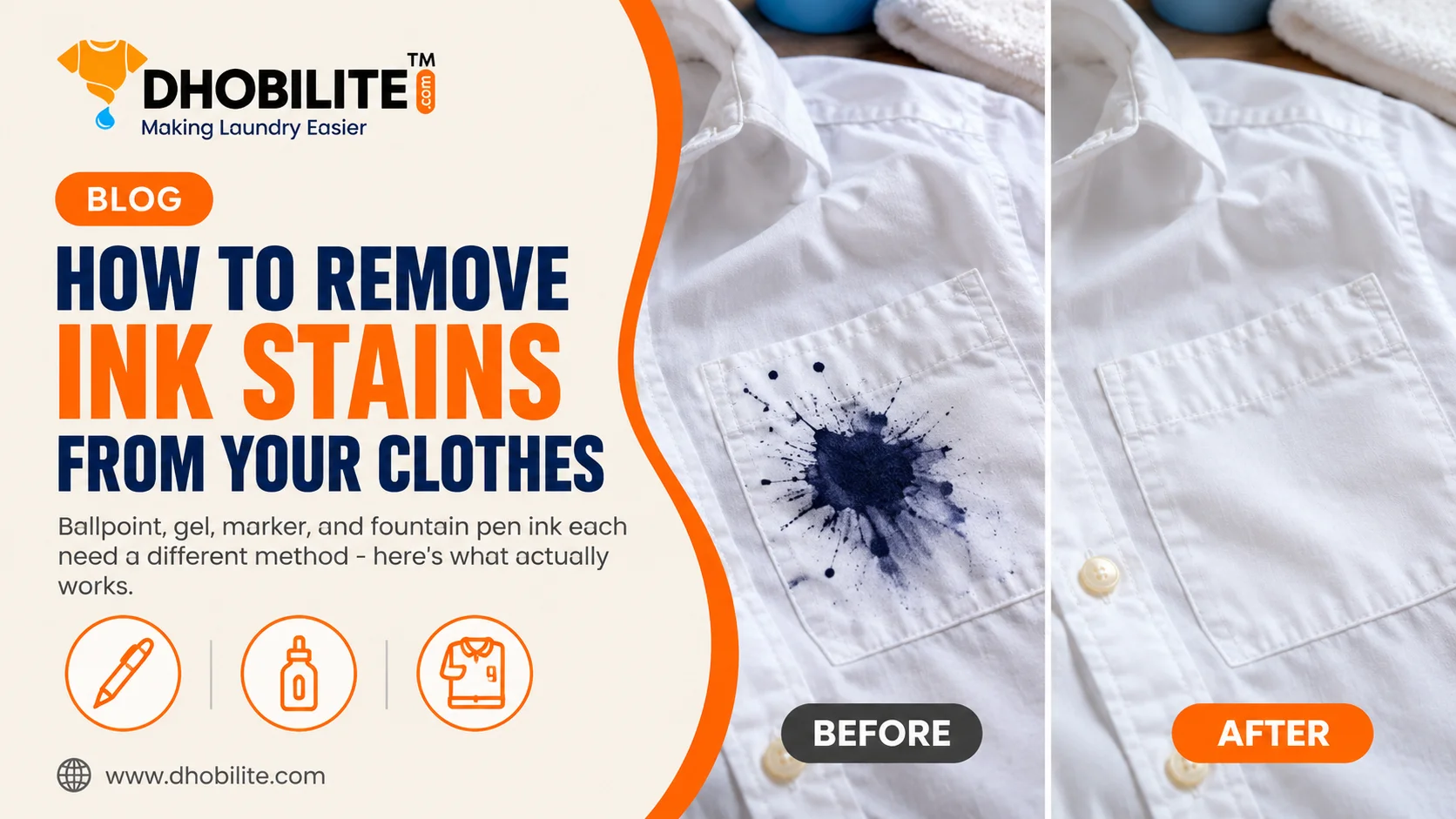
Not all ink stains behave the same way, and that’s exactly why so many home remedies fail. A ballpoint pen that leaked in your shirt pocket, a gel pen that burst in your bag, and a permanent marker mark on a school uniform are three different chemical problems wearing the same disguise. Treat them all with the same “dab some rubbing alcohol on it” advice and you’ll get inconsistent results – sometimes it works, sometimes the stain just spreads further into the fabric.
Here’s how to actually remove ink stains from clothes, matched to the type of ink and the fabric underneath it.
This builds on our broader guide on how to remove stains from clothes without ruining them if you want the fabric-care basics first.
Step 1: Check Two Things Before You Touch the Stain
Ink removal almost always involves a solvent of some kind, usually rubbing alcohol, so skipping this step is riskier here than with most other stains.
- Is the fabric acetate, rayon, or triacetate? Rubbing alcohol can dissolve or discolour these fibres outright, not just fail to help. Check the care label or the fabric content tag before reaching for alcohol – if it’s one of these three, skip straight to Step 3 below.
- Is it hand-wash-only or dry-clean-only? That label exists because the fabric can’t safely go through a normal wash cycle, which is usually also a sign it can’t take aggressive spot-treatment either.
If both checks are clear, blot (never rub) any wet ink immediately with a paper towel to stop it spreading further before you move to Step 2.
Step 2: Match the Removal Method to the Type of Ink
This is the part most advice skips, and it’s the reason the same method doesn’t always work twice.
Ballpoint pen ink is oil-based and dissolves well in alcohol. Place the stain face-down on a clean paper towel, then dab rubbing alcohol onto the back of the stain with a cotton ball. The ink should transfer onto the paper towel below – keep moving to a clean section as it lifts, rinse with cold water, then wash normally.
Gel pen ink carries more pigment suspended in a water-based gel, so alcohol alone often isn’t enough. Start by rinsing the back of the stain under cold running water, then work a small amount of dish soap or liquid detergent directly into the stain with your fingers before rinsing again. Follow with the same alcohol-and-paper-towel method used for ballpoint ink if any colour remains.
Permanent marker is solvent-based and genuinely harder to remove, especially once it’s dried. Rubbing alcohol still works best, but expect to repeat the blot-and-lift process several times with fresh paper towel sections rather than once. One common myth worth retiring here: hairspray “removes” permanent marker only because older formulations were alcohol-heavy – most hairsprays sold today contain little to no alcohol, so it’s an unreliable substitute for the real thing.
Fountain pen ink is usually water-based and the easiest of the four to treat. Cold water and a small amount of dish soap, worked in gently, lifts most fountain pen ink without needing alcohol at all. Save the alcohol method for the rare iron-gall or waterproof fountain pen inks that don’t respond to soap and water.
Step 3: When It’s Silk, Wool, or Already Dry-Clean-Only
Ink on a delicate or dry-clean-only garment isn’t a home-treatment situation, for a simple reason: the two things that remove ink well, alcohol and vigorous rubbing, are also the two things these fabrics tolerate worst. Alcohol can strip dye from silk, and wool fibres can felt or distort under the friction ink removal usually needs.
The same applies if you’ve already tried once and the stain has partially set, or dried in. A second home attempt on a stain that already resisted the first one tends to spread it or set it further rather than finish the job. At that point, professional dry cleaning – using solvents matched to that specific fabric – has a real shot at saving the garment where another round of home treatment would just add risk.
Common Mistakes That Make Ink Stains Worse
- Using hot water. Heat can set ink into the fibres the same way it sets blood and egg stains, turning a treatable stain into a permanent one.
- Rubbing instead of blotting. Rubbing pushes the ink deeper into the weave and spreads it outward, which is exactly how a small dot becomes a large faded patch.
- Applying bleach on a coloured garment. Bleach doesn’t discriminate between the ink’s colour and the fabric’s – it’s only safe on whites, and only after confirming the care label allows it.
- Skipping the fabric check before reaching for alcohol. Covered in Step 1, but worth repeating: this is the one mistake that can damage a garment that the ink stain itself never would have.
Frequently Asked Questions
Does toothpaste remove ink stains?
Not reliably. Toothpaste has mild abrasive properties that can help with some surface stains, but it does little against the dye in ink and the rubbing it requires can spread the stain further on fabric.
Can I use nail polish remover instead of rubbing alcohol?
Only acetone-based remover works similarly to alcohol, and it’s more aggressive – it can damage acetate and some synthetic fabrics even faster than rubbing alcohol can. Stick to rubbing alcohol unless you’ve confirmed the fabric can take acetone.
Why did the ink stain turn into a faded ring instead of disappearing?
That’s usually a sign the solvent spread the ink outward faster than it lifted it out, often from rubbing instead of blotting, or from working outward rather than always from the outer edge of the stain inward.
Is it true that milk removes ink stains?
Soaking in milk is an old home remedy with some real basis for certain natural-fibre, water-based inks, but it’s slow, inconsistent, and not something to rely on for a stain you need gone quickly or on a fabric you can’t afford to experiment on.
Related reading
How to Remove Stains from Clothes Without Ruining Them
7 Common Laundry Mistakes That Ruin Your Clothes (And How to Avoid Them)