Dear whoever is reading this,
I want to tell you something I did not plan.
When I started DhobiLite in 2011, I had a clear vision of what we were building. A tech-enabled laundry and dry cleaning network that would make laundry easier for every Indian household. I thought about the operations, the franchise model, the cities we would enter, the app we would build.
I did not think about the average age of the people who would build it with me.
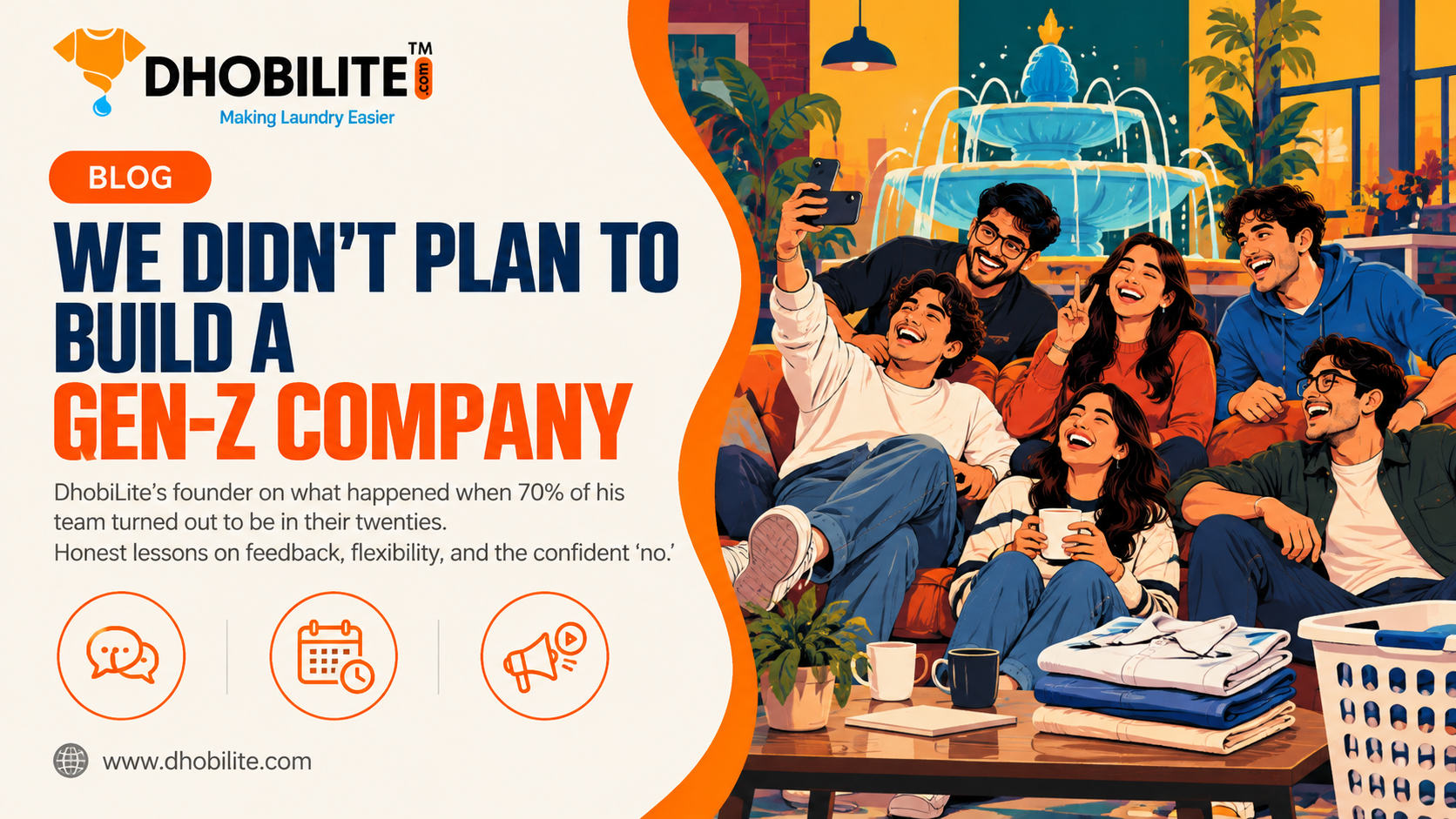
And yet, here we are. Fourteen years later, roughly 70% of our team is in their early twenties. We did not plan it. We did not set out to build a Gen-Z company. It just happened, slowly, one hire at a time, until one day I looked around the office and realized I was probably the oldest person in most of the rooms I walked into.
This is that letter.
The Moment I Realized Things Had Changed
I will be honest. I did not have one single dramatic moment of realization. It was more like a series of small ones that added up.
The first real signal came when most of the team started asking for work from home at least one day a week. Not demanding it aggressively, not threatening to leave, just asking for it clearly and explaining why it made them more productive. I noticed the way they asked. No nervousness, no over-apologizing. Just a calm, reasonable case for something they believed in.
I also noticed the energy they brought to every task, even the ones that were not glamorous. The same enthusiasm for a big campaign launch and for sorting through a spreadsheet. It was consistent in a way I had not expected.
And then there was the confidence. These are people in their early twenties who will walk into a room and say exactly what they think. Not rudely. Not recklessly. But clearly, without the layers of self-editing that I grew up thinking was professionalism.
That, more than anything, told me something had shifted.
The Thing I Did Not See Coming
I have been in business for over a decade. I have worked with people across many stages of their careers. And I thought I knew roughly what to expect from a young team. Some enthusiasm, some inexperience, a learning curve.
What I did not expect was how good they would be at saying no.
Not a defensive no. Not an avoidant no. A positive, reasoned, confident no.
“I do not think that approach will work because of this. Can we try this instead?”
“I am at capacity this week. If we take this on, something else has to move. Which one matters more?”
This kind of communication is something a lot of senior professionals never master. Our Gen-Z team walks in already knowing how to do it. I do not fully understand where they learned it. Maybe the internet. Maybe growing up watching everyone perform confidence online until it became real. Maybe they just grew up in a world that told them their opinion was worth saying out loud.
Whatever the reason, it changed how we run meetings. It changed how we set priorities. It made us a more honest organization because when people are not afraid to push back, bad ideas die faster and good ones get refined better.
The Thursday to Sunday Story
Here is a concrete example of what changes when your team is mostly Gen-Z.
Our back-end team used to have their weekly off on Thursday. It was set up that way for operational reasons that made sense at the time. The team asked if it could be moved to Sunday, like most of the rest of the office. They made their case. We discussed it. We changed it.
That sounds simple. And it was. But I want to be honest about the fact that before this team, that kind of change would have taken longer. There would have been more inertia, more “this is how we have always done it,” more reluctance to revisit something that was already decided.
What Gen-Z brought to DhobiLite is an impatience with arbitrary rules. If a rule exists for a good reason, they will follow it. If it exists because nobody ever questioned it, they will question it. And usually they are right to.
We are a better-run company because of it.
The Meme Reel Situation
I also want to tell you about the memes.
At some point, the team started making funny reels inside the office. About laundry. About themselves. About the chaos of startup life. I will not pretend I fully understood every reference. I will not pretend I did not occasionally wonder if this was how we wanted to represent the brand.
But here is what I noticed. The energy in those moments was genuine. The creativity was real. And the content, when it landed, connected with people in a way that a perfectly polished brand post sometimes does not.
There is something about Gen-Z’s relationship with authenticity that is different from what came before. They can tell immediately when something is performative. They respond to things that feel real, even if real is a little messy, a little unpolished, a little silly.
The meme reels taught me that. We are still figuring out the right balance. But I would rather have a team that wants to create things and needs some direction than a team that waits to be told exactly what to make.
What I Have Had to Unlearn
Building a Gen-Z team has required me to unlearn some things I thought were fixed.
I used to think that presence meant productivity. That if people were in the office, work was happening. That is not how this team thinks, and honestly, the results have shown they are right. Output matters. Presence is a tool, not the goal.
I used to think feedback flowed mostly downward. That leadership set the direction and the team executed. This team has made feedback genuinely bidirectional. They will tell you when something is not working. They will tell you when the culture needs to change. They will tell you when they feel underused or overloaded. And if you are not listening, they will quietly stop putting in more than what is required.
I have also had to accept that the career timeline I grew up with does not apply here. This generation is not willing to spend three years proving themselves before they get any real responsibility. They want meaningful work faster. And if you give it to them, they deliver. If you make them wait, they leave.
None of this is a complaint. It is an adjustment. And the adjustments have made DhobiLite better.
What Has Not Changed
Through all of this, the mission has stayed the same.
We are building something that matters. We are trying to make a daily necessity more reliable, more professional, and more convenient for millions of Indian households. That is not a glamorous pitch. We are not building a social app or an AI tool. We are building a laundry network.
And what I have found is that this Gen-Z team cares about that mission more than I expected. They want to work on something real. Something that has a physical presence in the world, that serves actual people, that you can see working when you walk into a partner outlet or track an order on the app.
They bring their whole selves to that work. The energy, the honesty, the creativity, the confident no, the meme reel. All of it.
I did not plan to build a Gen-Z company.
But I am glad this is the company we became.
Nishant Tripathi Founder, DhobiLite
P.S. If you are in your early twenties and you read this and felt something, we are hiring. Come find out if the letter holds up in real life. I think it does.
Internal links
| Anchor | Link |
| “we are hiring” (P.S. section) | https://www.dhobilite.com/careers |
| “DhobiLite in 2011” | https://www.dhobilite.com/about-us |
Find out more about DhobiLite at https://www.dhobilitereview.com/